
Since 1890, Sutphen Corporation has been making products firefighters use every day to mitigate a variety of incidents. When a Sutphen fire apparatus rolls down a street, it is readily identifiable as a Sutphen with its well- known headlight bezels on the front of the cab and its siren mounted through the front grille.
Sutphen has been a family-owned business for 135 years. Originally founded by C.H. Sutphen, the fourth and fifth generations of the Sutphen family are currently at the helm of the 135 year-old business. Leading the company are fourth- and fifth-generation family presidents, Shelby Sutphen Chambers and Julie Sutphen Phelps.
C.H. Sutphen’s son Harry joined the company after World I, and his sons Tom and Bob ran the the company until Bob’s son, Drew, and Tom’s daughter, Julie, became the leaders of the business in the 1990s with Drew overseeing Sutphen Dublin and Urbana and Julie overseeing Sutphen Hilliard and East. It was Tom Sutphen who, in 1958, started developing what has become a staple of Sutphen’s production offering: the Sutphen aerial.
According to Dan Sutphen, a fourth-generation family member and the vice president of sales, after the company began developing aerial prototypes, the company’s first-ever Sutphen aerial truck was ready and officially debuted at FDIC 1964. After the demonstrations, Sutphen sold the truck to the city of Norwalk, Ohio. Dan Sutphen says, “Tom saw an opportunity to provide a stronger, safer aerial device for the fire service by developing a four-sided box boom design. Inspired by this vision, he entered the aerial device business and created a product that continues to set the standard for strength, safety, and reliability in the fire service.”
Sutphen’s first aerial product—a 65-foot aerial platform quint—was born from Tom Sutphen’s vision. He sought to create a fire apparatus that prioritized safety for both firefighters and victims. “Rather than requiring individuals to climb a ladder,” says Dan Sutphen, “this new platform allowed them to ‘take an elevator’ directly to the scene, revolutionizing fireground accessibility and rescue operations.”
Aerial Evolution
That original 65-foot quint telescopic platform has seen decades of innovation and refmement, yet many of its core design principles are still evident in today’s Sutphen midmount aerials. These include the following:
- Lightweight, heavy-duty aluminum aerials that reduce wear on the trucks while improving braking and engine performance.
- Huck-bolted aerial devices that provide superior strength, rigidity, and ease of maintenance.
- Self-leveling platforms that function like a Ferris wheel, keeping firefighters and victims safe and upright within the bucket regardless of aerial positioning.
- This benefits production pace, quality, workflow and much more“
Despite these consistent design philosophies, today’s apparatus are significantly more advanced than the original,” says Dan Sutphen. “Major improvements have been made in the body and chassis design, including enhanced body compartments, increased cab safety, and greater chassis capacity. Over 60 years later, Sutphen continues to build upon its legacy of innovation, safety, and durability in aerial fire apparatus.”.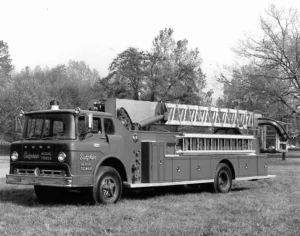
Customers can ask questions and tangibly see how the most extreme-duty chassis in the industry is built. Once you see Sutphen’s dedication to the details, you will understand what sets the Monarch Extreme-Duty chassis apart from the rest of the industry.
Building the aerials with lightweight heavy-duty aluminum reduces overall apparatus wear while providing a strong, secure climbing surface for firefighters. Each device is Huck-bolted for superior strength under demanding conditions and simplified maintenance throughout its service life. “Our aerial platforms feature a box boom design that protects vital airways, waterways, and key electrical components while also ensuring a stable and secure working environment in the bucket,” says Dan Sutphen. And, the company’s aerial ladders are similarly constructed, he adds, with Huck-bolt technology and high- strength aluminum.
One of the most innovative and distinctive apparatus in Sutphen’s product offerings is the firefighter-focused SPH 100. This 100-foot, midmount aerial platform has numerous firefighter-friendly functions including its bucket, which has several key features including its integrated permanent Stokes arms for secure and efficient rescues; a built-in parapet ladder for easy and direct rofftop access; dual adjustable monitors that can flow water in any direction at any time; nearly 20 cubic feet of internal space for organized operations; four access and egress doors to improve safety and resuce evacuation time; and tip loads of 1,000 pounds dry and 500 pounds wet, supporting a variety of fireground tasks. Dan Sutphen adds, “When paired with Sutphen’s signature four-sided box boom, these features deliver unmatched stability and reliability—even under the most intense and unpredictable emergency conditions.”
The company initially specialized in midmount aerials because the lower center of gravity and more balanced weight distribution allowed a safer driving experience. They also allow operators to approach a fire scene with improved maneuverability and better sightlines.
It also initially produced its aerial products on single rear axles, like the current SL 75 and SP 70, but expanded the product line to include tandem axles over time. Reasons for the evolution include addressing the need for increased braking capability and expanded equipment storage. The larger body provided by tandem axles provides fire departments with signicant- ly more compartment space.
In 2016, Sutphen debuted its rear-mount aerial, the SLR 75, at FDIC International, bringing the company’s extreme-duty manufacturing capabilities to rear-mount offerings. Then in 2018, Sutphen debuted its SLR 108 to provide a product offering to customers wanting a tandem-axle rear-mount product. These units deliver Sutphen’s trusted performance and durability in a rear-mount configuration.
Sutphen’s newest aerial product is its tractor-drawn aerial (TDA). Market research revealed that there was demand for a Sutphen- built TDA, and this product delivers performance and reliability from Sutphen’s extreme-duty manufacturing. “From the Extreme-Duty Monarch Chassis to the stainless steel body and Huck-bolted aluminum aerial ladder, the Sutphen TDA is a powerful and tested addition to our family of aerials,” says Julie Sutphen Phelps. “As of today, Sutphen offers two TDA options, one with a 101-foot ladder and one with a 105-foot ladder.”
City of ORLANDO (FL) Fire Department
The City of Orlando Fire Department is a long-time customer of Sutphen and standardized on Sutphen fire apparatus many years ago for its engines and aerials. According to Assistant Chief Aaron Rhodes, “This is a company that’s based on a lot of the same values we have as a fire department. They’re looking for quality, consistency. They’re specialized. It’s the same folks building apparatus rig in and rig out.”
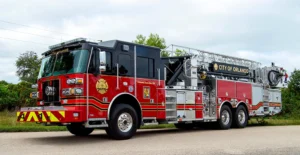
Orlando is 100% midmount platform across the board—there are no straight sticks in the department. It does currently run one 70-foot aerial, and at one time it did have a 110-foot aerial in its downtown district. The department is currently in the process of adding an SPH 100 to its fleet. Rhodes says this rig is a testament to Sutphen’s ability to customize. “If you look back at our last few builds, we had some differences in our spec,” he says. “We stretched the cab out, we put a bigger bumper on it for some bigger items and put a higher cab on it.” But, on this new rig, the department reduced all that. “By taking the extended cab off, the raised roof off, and shortening the bumper up, the same SPH we just ordered is five feet shorter,” Rhodes adds. “We were able to get five feet out of that truck and not lose one inch of aerial device, and that’s a big deal.
In terms of how Sutphen aerials have impacted Orlando’s operations, Rhodes says that the durability of the aerial device itself has been a key component.
Remaining Innovative
Shelby Sutphen Chambers, fifth-generation family president, says that continuous improvements and a commitment to family ownership have shaped the legacy of every Sutphen product and that they are the driving forces that will carry Sutphen into the future for generations to come. “Innovation and continuous improvement are at the core of Sutphen’s operations and manufacturing processes,” she adds. “While our products have stood the test of time, it’s our ongoing commitment to evolution that keeps them at the forefront of the industry. Every day, we pursue new opportunities—both large and small—to enhance and refine our apparatus, delivering solutions that empower firefighters to save lives and protect property.